Testimonies of Pula’s Past: Demographics & History
When exploring history, we most often rely on major events, wars, and charters. However, the true picture of society, the rhythm of daily life, and real people are hidden in archival material that we rarely have the opportunity to study in detail – parish registers. The practice of systematically recording births, marriages, and deaths began thanks to the Council of Trent (which concluded in 1563), providing a powerful and decisive impetus for maintaining such registers across the Catholic world.
For the city of Pula, these precious documents spanning from the beginning of the 17th century to 1815 are today carefully preserved in the State Archives in Pazin. The first surviving entry in Pula’s baptismal register (Liber Baptizatorum) dates back to October 18, 1613. It was personally recorded in the first person by the canon and parish priest of the Pula Cathedral at the time, Natale de Franceschi.
What do these meticulously written lines – in which fine calligraphy intertwines with damage caused by moisture and rodents – tell us about Pula back then?
Numbers That Tell a Story: Demographic Growth of Pula
During the period from 1613 to 1815, exactly 5,910 entries were recorded in Pula’s baptismal registers. Since all children were baptized at the time, this figure also serves as an indicator of the number of births. An interesting fact is that the vast majority of the text was written in Italian, while Latin was used in a relatively small number of cases – only 255 entries were in Latin, or a mere 4.31%.
In the 17th century, the numbers were extremely low. For example, in 1613 and 1647, only three people were baptized each year. However, the reason for 1613 is simple: the parish priest only began keeping the book in October. Entering the 18th century, the picture changes. The city was clearly recovering demographically, as 53 children were baptized in 1715, and a record of 58 baptisms was noted in 1798.
It is also interesting to see during which part of the year most children were born. January convincingly leads with 623 entries. With the arrival of summer, the numbers drop, and the fewest baptisms occurred in May (350) and June (333).
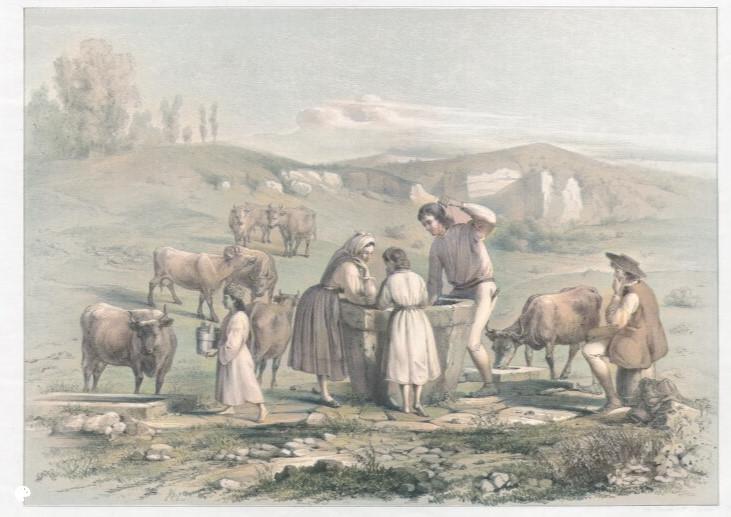
A depiction of daily life and labor in Vinkuran near Pula (Le Cave Romane presso Pola). This 1842 print depicts local residents, livestock, and work in the ancient Roman quarry – the environment in which generations of Pula residents recorded in the parish registers lived and worked.
Source: Austrian National Library (ÖNB) / B. Linassi e Co., Trieste (1842)
Identity Before Surnames: “Son” and “Daughter”
If you were to search for your ancestors in Pula’s early parish registers today, you would quickly run into an obstacle: there are no surnames. In the 17th century, the parish priest knew his parishioners perfectly well and had no need to identify them further. Instead of a surname, he would simply add figlio (son) or figliola (daughter) next to the child’s name, and he would often use a diminutive. Surnames only began to be regularly recorded at the beginning of the 18th century.
When the priest truly did not know the name of the person present, he would write the abbreviation N. N. (Nomen nescio) in the column.
Strict Church Bureaucracy and Inspections
Maintaining parish registers was not taken lightly, and church authorities enforced strict controls. When the Bishop Inzaghi of Pula inspected the baptismal registers on February 7, 1775, he noticed oversights and issued clear, rigorous instructions for their keeping:
- He ordered that empty spaces left in the books be filled in.
- He required that every entry must include a date.
- He insisted that in the future, the exact day, and if possible the exact hour of the child’s birth, must be specified.
Priests also had their own specific customs when writing entries. They often marked the first entry of a new year with pious abbreviations such as D. O. M. (Deo Optimo Maximo), alongside the words Anno Nuovo (New Year) or Anno Santo (Holy Year). At the end of his pastoral service, a priest was required to leave a written certification. Thus, in 1796, parish priest Don Giacomo Demori personally handwrote a statement confirming that he had personally and properly registered all those baptized from the beginning of his service up to that day.
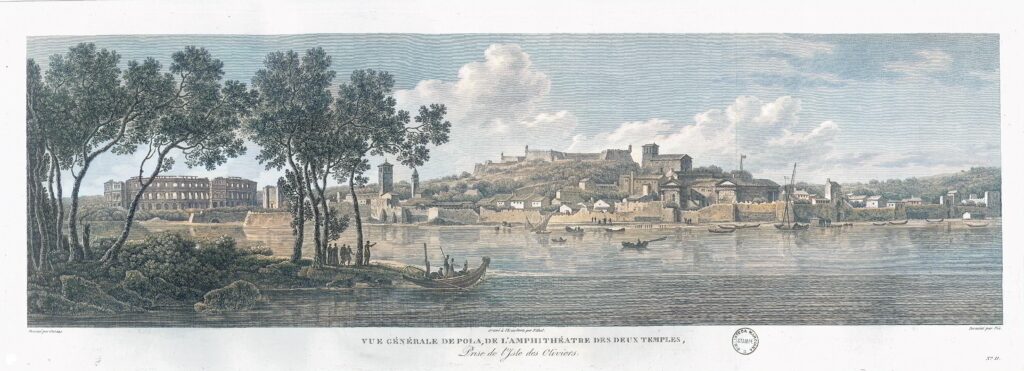
This French townscape from the turn of the 19th century provides a clear view of Pula during the era described by the analyzed parish registers. The city was still located within its old defensive walls right along the seashore. On the right side of the image, not far from the Kaštel fortress, the Pula Cathedral complex with its bell tower stands out clearly. This is the very cathedral where parish priests, starting with Natale de Franceschi, recorded baptismal registers and where Bishop Inzaghi conducted the aforementioned strict inspection of parish books in 1775. Looking at this engraving gives us an authentic visual framework of the city in which its inhabitants lived their daily lives.
Source: Vue générale de Pola… (General View of Pula), print based on drawings by French painter Louis-François Cassas from the late 18th century (published in the travelogue Voyage pittoresque et historique de l’Istrie et de la Dalmatie, 1802).
In the second part, we explore the social strata of Pula – from the nobility and proveditore to housemaids – as well as unusual situations when choosing godparents, which were dutifully recorded in church registers (link).
Source material: Bertoša, S., Život i smrt u Puli (Matica hrvatska, Pazin, 2002)
One Comment