How the Croatian Checkerboard Was Created: From the Bulwark of Christianity to Independence
An interesting fact is that the Croatian checkerboard (šahovnica) is not the oldest Croatian symbol: that title belongs to a mark found on a minted coin from around 1200.
From the very beginning, a coat of arms represents much more than an ordinary picture. People have always wanted to be recognized by others for something, and this need is equally strong in individuals as it is in large communities, all the way up to the level of the state itself. The first sign of recognition is usually a name, and naturally accompanying it are a flag, an anthem, and a coat of arms. A good coat of arms is never just a mere visual ornament: in moments of success, it awakens pride in people, and in times of peril, it serves as a powerful call to defend the community.
The Croatian coat of arms confirms this better than many others because its history is actually the history of the Croatian lands themselves—their painful disintegration and exceptionally long, arduous reunification. Historians point out one important fact: understanding the coat of arms as an exclusive symbol of a nation is relatively young. It only began to take serious shape in the mid-19th century, and was completed only with the establishment of state independence in the early 1990s.
What is a coat of arms and how to read it
Coats of arms are studied by heraldry, a branch of auxiliary historical sciences that bases its conclusions on preserved material monuments. The coat of arms in its true sense was born in the Middle Ages, in the chaotic era of the Crusades, when feudal lords began decorating the shields of their military units with colors and figures to visually distinguish themselves from the enemy in battle. Around 1130, such decorated shields appeared in France, Germany, Flanders, and England, and from there they spread unstoppably throughout the rest of Europe.
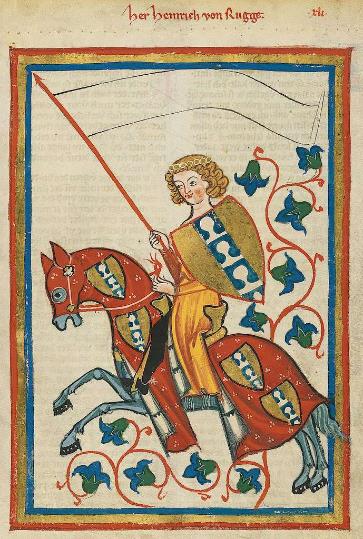
Knight with a heraldic shield and horse tack (Codex Manesse, c. 1305–1315). Medieval nobles and warriors decorated their shields, equipment, and flags with recognizable colors and symbols to visually distinguish themselves in battles. Source: Codex Manesse (UB Heidelberg, Cod. Pal. germ. 848, fol. 122r), Wikimedia Commons / Public Domain
The coat of arms then became a clear sign of a privileged class position, and from the 13th century, the exclusive right to grant coats of arms passed into the hands of rulers. Strict design rules were kept by heralds, experts at the courts who rose to become very influential officials towards the end of the 14th century. They developed blazoning—a specific skill of describing a coat of arms in words, which ensures that every coat of arms can be perfectly and accurately drawn and reconstructed even without a picture. In addition, rulers often included in their own coats of arms the symbols of the lands they actually ruled, but also those to which they merely laid claim. Today, we call such “desired” coats of arms arms of pretension.
A few basic rules greatly facilitate the reading of old coats of arms:
- Right and left: In classic historical descriptions of coats of arms (blazons), the sides are always viewed through the eyes of the warrior holding the shield. Therefore, an animal that in old grants of arms (like the one for Slavonia from 1496) “moves to the right,” actually walks towards our left side in the drawing. For simplicity, the modern Croatian Law of 1990 describes the coat of arms from the observer’s perspective, stating that the marten walks to the left.
- Colors and metals: Yellow and white colors on shields actually designate precious metals—gold and silver.
- Lions and leopards: The heads of wild cats facing the observer directly are called leopards in heraldry, while those depicted in profile are lions. That is why the Dalmatian coat of arms is technically described as being adorned with three leopard heads (two above, one below).
- On old seals and stone reliefs, metal was often distinguished from color solely by the height of the carved field, but experts still do not always agree on the reading today: older authors usually interpret the raised field as color, while recent research more often reads it as metal.
The Crescent, the Morning Star, and the Marten
To understand the earliest Croatian symbols, we must return to the era before the emergence of strict heraldic rules with shields. Long before the appearance of true coats of arms, lands were marked with recognizable symbols on minted coins. On the silver frisatic coins of Duke (knez) Andrew from around 1200, there is an inscription with the name of the Croatian duke, and next to it, a crescent moon and the morning star (Danica). This is the first time these two symbols are found. These figures stand freely on the coin, not within a set shield shape, so this is actually a pre-heraldic sign of belonging, not a coat of arms in the strict sense of the word.
Silver denarius (frisatic) of Duke Andreas (c. 1200). The image shows both sides of the first coin of Duke Andreas (Rengjeo, type 1). On the obverse (left), the crescent and star standing freely in the center are clearly visible, while the reverse (right) features a gable with two towers—a motif literally borrowed from Bavarian frisatics of that era. Source: Draft according to I. Rengjeo (1959), taken from: R. Smajlagić, “Croatian frisatics – the first Croatian coin (2)”, Numizmatičke vijesti, no. 62, 2009.
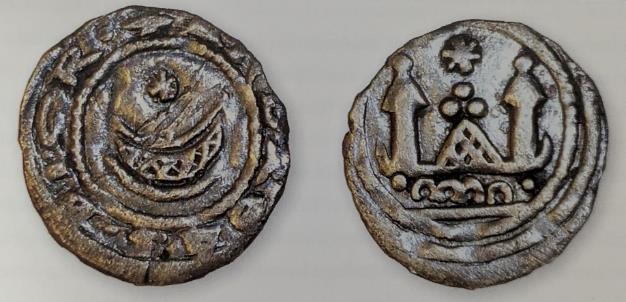
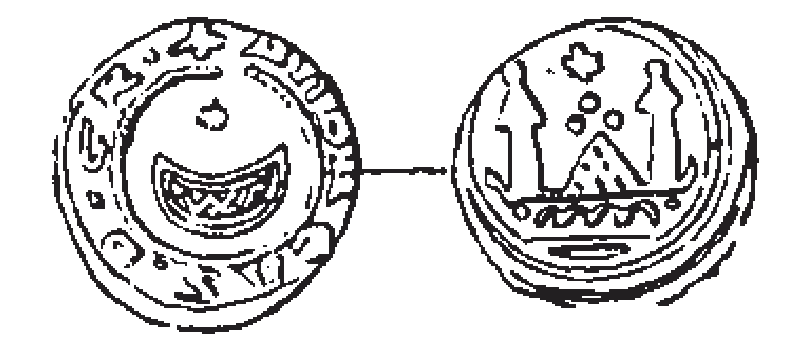
Older interpretations (Dubravka Peić Čaldarović and Nikša Stančić) often declared this motif the “oldest Croatian coat of arms” and the first sign linking the Croatian name to a political territory, while recent historical interpretations (Mate Božić and Stjepan Ćosić) offer a different picture. According to them, these figures were simply adopted from Salzburg coins as a commercial and minting pattern, to which its modern meaning was attributed only at the beginning of the 20th century during the formation of the modern nation. While this coin of Andreas bears the image of a church with two towers on the reverse, other Árpád-era coins of that era feature a lion walking—the well-known dynastic symbol of the Árpád dynasty.
This same lion continues to appear on later Slavonian banovacs (banal denarii), and it is precisely in this figure that people later begin to see a marten. According to older, traditional interpretations, the marten first appeared in 1237 when King Bela IV issued a coin “for Slavonia”. It was logically linked to the kunovina, a mandatory tax in Slavonia that for centuries was literally paid with marten pelts. However, recent historiographical analyses (Božić and Ćosić) consider that this figure was a lion from the very beginning. It was only at the end of the 15th century that it started being recognized as a marten, prompting Renaissance humanists to connect the star above it with the planet Mars, relying on the Latin name for the marten (martes). The marten received its final, official status in 1496, when King Vladislaus II granted the Slavonian nobility a coat of arms with this figure at their explicit request.
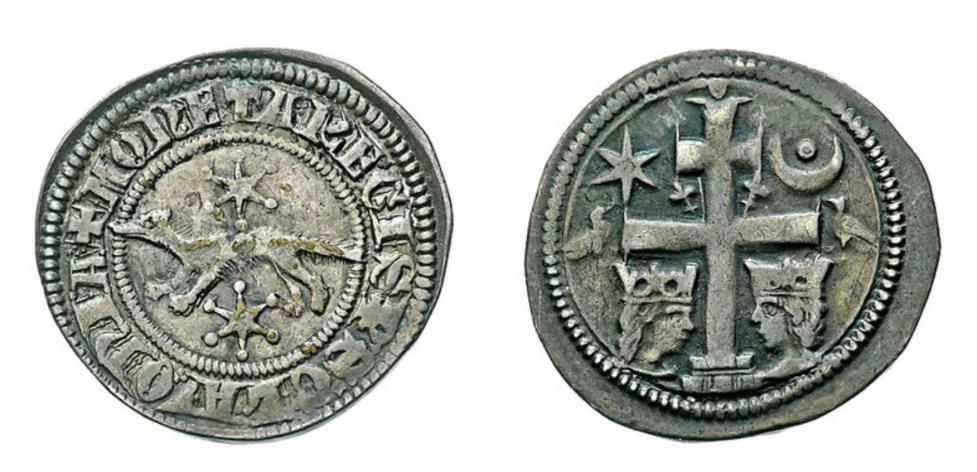
Slavonian banovac (denarius) of King Bela IV (1235–1270). Left (obverse): The figure of an animal in mid-stride (traditionally a marten, originally a lion) between two stars with the inscription MONETA REGIS SCLAVONIA (Coin of the King of Slavonia). Right (reverse): A double (patriarchal) cross with two crowned heads and the motifs of a star and crescent at the top. Source: Numista.com / Numismatics.hu (Catalog ÉH# 2)
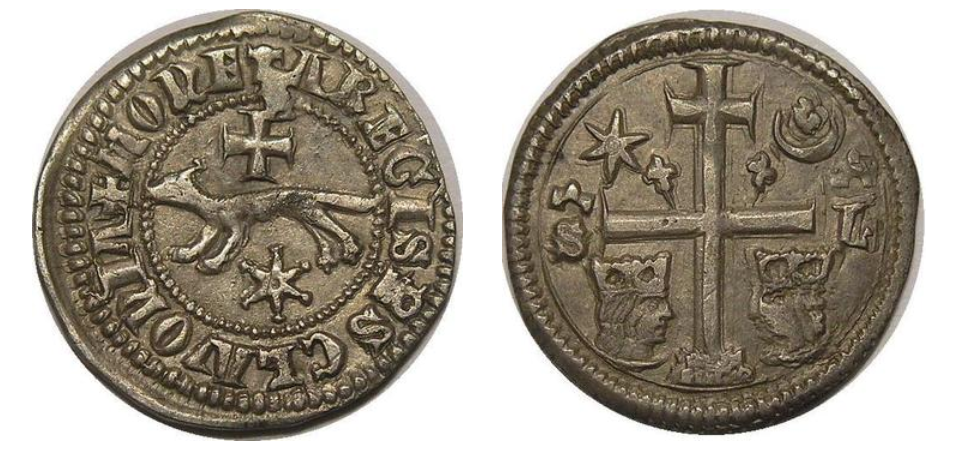
Slavonian banovac of Ban Stjepan Babonić (1280–1282). The visual transformation is best observed when we compare the early Bela banovac with the later banovac of Ban Stjepan Babonić (1280–1282). While on the earlier coin the animal had a more massive body and a stronger head resembling the originally minted lion, on the Babonić specimen the figure acquires a much slenderer body, a pointed snout, and a bushier tail—which testifies to how, through decades of minting, the earlier depiction of the lion on the molds gradually transformed into the figure of a marten. Source: Numista.com / Numismatics.hu (Catalog ÉH# 19)
Three leopard heads and the disintegration of territory
The oldest preserved heraldic depiction on Croatian soil is actually a stone emblem with three crowned heads found in the Ostrovica fortress, dating back to the mid-14th century. Its appearance is tied to the strong expansion of royal power during that period. Namely, the Hungarian-Croatian King Louis I of Anjou (ruled 1342–1382) initially held authority only over Slavonia. However, he subsequently militarily broke the independence of the powerful Croatian princes Nelipić and Bribir, and finally, with the Treaty of Zadar in 1358, triumphantly reclaimed all of Dalmatia from Venice. Thus, he united the Croatian lands under his firm rule, and the coat of arms with three lion heads began to represent this unique, crowned kingdom.
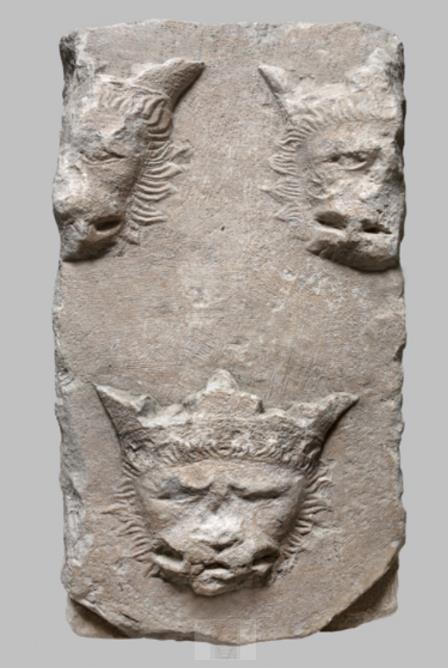
Stone relief with three crowned heads from the Ostrovica fortress (mid-14th century). The oldest known heraldic symbol of the Croatian lands preserved in stone. It depicts three crowned leopard (lion) heads, found at the site of the Ostrovica fortress near Bribir. Source: Vedrana Delonga, “Dalmatia – the Croatian rose of the worlds”, CROMA Co., Stobreč, 2011 (p. 111)
Interestingly, this symbol, the three crowned heads, is hidden in one of the most famous European armorials, that of the Belgian herald Gelre, which was created from 1370 to 1414. The only question is whose coat of arms it actually is. Older authors (Peić Čaldarović and Stančić) believe it belongs to Louis I and was created during his time, between 1370 and 1382. Recent research (Božić and Ćosić) sees it differently. According to them, the armorial contains the coat of arms of King Sigismund (who ruled after Louis), added only later, and the clue that leads them to this is the colors. Sigismund, in fact, turned the old leopard heads on a blue background into lion heads in profile on a red one, and it is precisely such heads that we see in Gelre. As a permanent, official symbol of the entire kingdom, this coat of arms only appeared at the beginning of the 15th century, a bit later than older interpretations suggest.
Unfortunately, after that epoch, the unified Croatian territory began to inexorably disintegrate. In the 15th century, Venice once again and permanently took over Dalmatia, while the tragic fall of Bosnia in 1463 and the heavy defeat at the Battle of Krbava Field in 1493 turned the remaining Croatian lands into a bloody battlefield and a narrow defensive belt. As a visual reflection of this severe political division, the northern Croatian lands and Slavonia received their own separate coats of arms (the checkerboard shield and the marten), and that old, unique royal symbol with the three heads was reduced exclusively to the regional, titular symbol of Venetian Dalmatia.
The Mystery of the Croatian Checkerboard
While the old royal sign with the three heads was thus left to Dalmatia, the famous red-and-silver fields appeared as the new symbol of Croatia proper towards the end of the 15th century, within the sphere of Habsburg politics. The Habsburgs had used the three lion heads as a coat of arms of pretension for Croatia since Frederick III, but the German King Maximilian I included the checkerboard shield in his coat of arms around 1495. This is the first known such depiction in history, and next to it stands the coat of arms with the three heads, now clearly designated as the coat of arms of Dalmatia. These depictions are preserved on frescoes in Bolzano and on a historical house in Innsbruck.
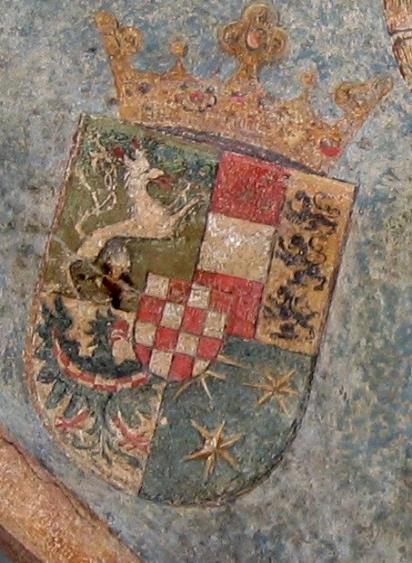
Wall painting on the ceiling of the Stadtrichter Zeller Haus in Innsbruck, created during the era of the German King Maximilian I of Habsburg. Source: Darko Žubrinić, “Croatian Coat of Arms during centuries” (croatianhistory.net, Zagreb, 2005)
Older authors note that a similar square decoration exists on numerous early medieval monuments, but there is no evidence that it served as a symbol of state authority in that early period. On the other hand, recent research (Božić and Ćosić) offers a different interpretation: they claim that the emperor envisioned this sign as a stylized rampart in Habsburg colors, inspired a year earlier by the fact that the Croatian nobility at the parliament in Bihać in 1494 highlighted Croatia’s role as the ‘fortress and bulwark of Christianity’ in a letter to European rulers.
In that same turbulent period, specifically a year later (1496), King Vladislaus II issued the previously mentioned armorial charter by which he officially confirmed the coat of arms with the marten to Slavonia. As for the Croatian nobility themselves, they first used the checkerboard shield, as far as is known, on January 1, 1527, on the seal of the charter by which the Parliament in Cetingrad elected Ferdinand of Habsburg as their new king. It is believed that this seal was probably commissioned by Ferdinand himself, given that the exact same one was never used again later. Throughout history, the number of fields on the shield constantly varied from 4×4 to as many as 8×8, and the color of the first field was not fixed either. Only from the second half of the 19th century did the 5×5 field shape begin to visually standardize, while in the 20th century, a red starting field completely prevailed in official use.
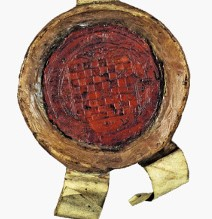
Seal of the Cetingrad Charter (January 1, 1527). The first preserved use of the checkerboard shield by the Croatian nobility themselves on the document by which Ferdinand I of Habsburg was elected Croatian king. The seal contains a checkerboard with 64 fields (8×8). Source: Croatian State Archives / Wikimedia Commons (Public Domain)
Remnants of remnants and the joint Parliament
The election of Ferdinand of Habsburg in 1527 was a desperate attempt at defense because, when the Ottomans occupied most of the country, so little remained of the former kingdoms that the phrase “remnants of remnants” (reliquiae reliquiarum) became customary. The danger forced the nobles into unity: in 1553, the Croatian and Slavonian parliaments sat together for the first time to agree on defense. The Croatian parliament south of Gvozd met independently for the last time in 1557 (some sources state 1558), and since then, there has only been one joint Parliament of Croatia and Slavonia.
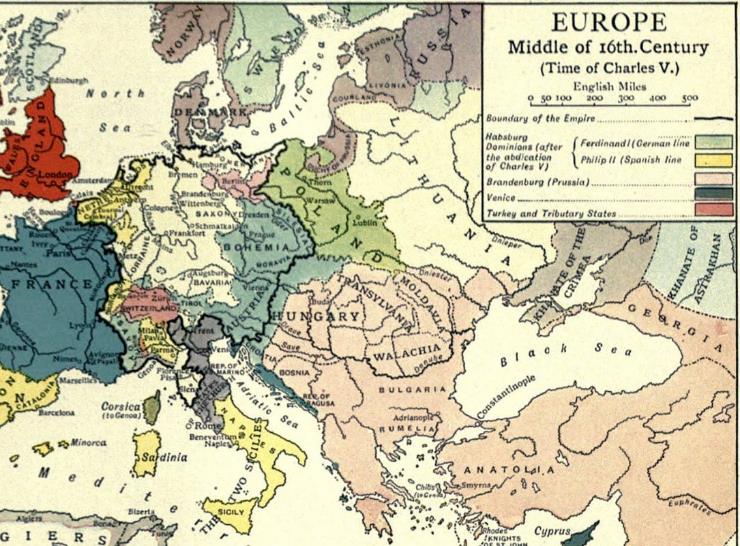
Map of Europe in the middle of the 16th century (era of Charles V and Ferdinand I). Shows the geopolitical map of Europe during the time of the Ottoman conquests and the formation of the Habsburg Monarchy. It clearly displays the dramatic pushback of the Croatian lands into a narrow defensive belt (“remnants of remnants”) under the pressure of the Ottoman Empire from the east and the Venetian Republic from the coast. Source: Encyclopædia Britannica (11th edition, 1911) / Wikimedia Commons (Public Domain)
With this, the map of names also shifted. The center of gravity of the state moved to the safer Upper Slavonia, between the Kupa and Drava rivers, and with it, the center of Croatian statehood and name moved to the north. Slavonia remained only in the east, under Ottoman rule. In the joint parliament, the tone was still set by the older Slavonian nobility, so the Slavonian coat of arms had priority: until 1847, parliamentary documents were certified with the seal bearing the marten.
The Croatian checkerboard in the 19th century and the path to reunification
Following the great wars of liberation at the end of the 17th century, most of the occupied Croatian territories were finally liberated, and the nobility began to loudly demand the restoration of the old entirety. The coats of arms of the three separated kingdoms began to appear together more frequently. The first known depiction of all three coats of arms united in a single shield is found on the magnificent tombstone of Ban Toma Erdődy in the Zagreb Cathedral from 1624. At the turn of the 17th to the 18th century (around 1700), the visionary Pavao Ritter Vitezović, in his work Croatia rediviva (Revived Croatia), finally and boldly called all these fragmented lands by one common name—Croatia.
In the 19th century, this integration process accelerated. Dragutin Rakovac noted in 1842 that in politics, instead of the cumbersome “Dalmatian-Croatian-Slavonian” name, the Croatian one was increasingly used alone. The Illyrians at that time strongly highlighted the old motif of the crescent and the morning star (which they called “leljiva”), but that sign never took hold as the official coat of arms of the Triune Kingdom. The integration program received its strongest expression in 1848 on the famous flag of Ban Josip Jelačić: the coats of arms of Croatia, Slavonia, and Dalmatia were placed diagonally on it so that they amicably touched at their upper edges, a joint crown watched over them, and the Illyrian crescent and star stood between them as a gesture of reconciliation in the space between them.
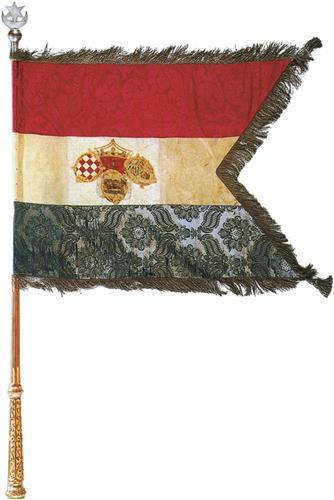
Flag of Ban Josip Jelačić (1848). The first official national tricolor on which the diagonally placed coats of arms of Croatia, Slavonia, and Dalmatia were visually united under a common crown. The shields are crowned with a golden crown and the Illyrian leljiva, and the same Illyrian symbolism is located at the top of the flagstaff. Source: Proleksis Encyclopedia online (Miroslav Krleža Institute of Lexicography)
Later, the Croatian-Hungarian Settlement of 1868 declared a similar united coat of arms as the official symbol of the Kingdoms of Dalmatia, Croatia, and Slavonia, which lasted until the fall of the Monarchy in 1918. However, in the everyday practice of parties and the public, the shield with the checkerboard fields was increasingly accepted exclusively as the prevailing coat of arms of Croatia.
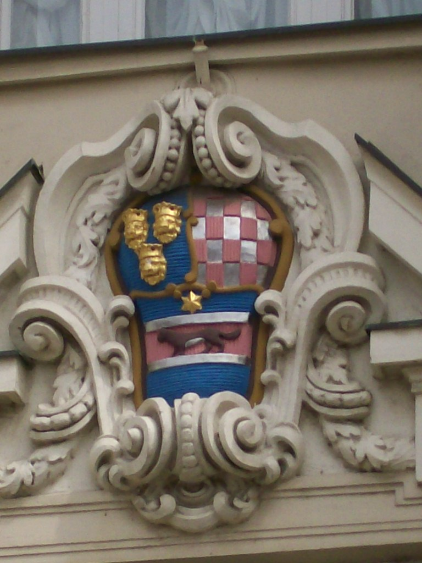
Coat of arms of the Triune Kingdom on the facade of the Croatian Parliament in Zagreb. The united coat of arms of Dalmatia, Croatia, and Slavonia resulting from the Croatian-Hungarian Settlement (1868), carved on the Parliament building in St. Mark’s Square. Source: Wikimedia Commons (File:Coat Croatian Parliament.jpg)

Birth of the modern coat of arms
Until 1941, the Croatian coats of arms bore a crown, and which one depended on who was ruling: the Austrian imperial or the Hungarian royal crown, and after 1918, the Karađorđević dynasty. From 1941, the shield began to be supplemented with political messages. On the coat of arms of the NDH (Independent State of Croatia), it was the Ustaše symbol in a interlace frame, and on the coat of arms of post-war, socialist Croatia, a red five-pointed star with wheat and an anvil, symbols of the alliance of workers and peasants.
The last major change arrived in December 1990. The Parliament, elected in the first multi-party elections, passed the Law on the Coat of Arms, and President Franjo Tuđman proclaimed it on December 21. The expert foundation was created by a commission chaired by Academician Nikša Stančić, and the proposal for the coat of arms was the result of teamwork, in which Tuđman and the President of the Parliament, Žarko Domljan, also participated. The coat of arms was intended to convey two things: that the Croatian state has historical continuity and that its territory is whole. The visual design was created by Academician Miroslav Šutej. The result is the Croatian checkerboard with a crown containing five smaller shields: the crescent and star, which the law calls the oldest known coat of arms of Croatia, followed by the Republic of Ragusa (Dubrovnik), Dalmatia, Istria, and Slavonia.
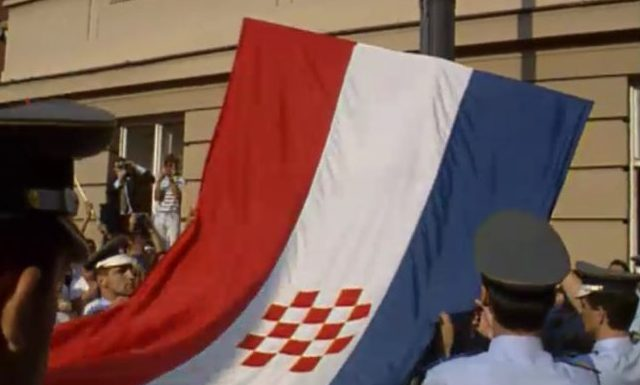
Raising the new Croatian flag in front of the Parliament (July 25, 1990). The historic moment when, following the adoption of constitutional amendments in the summer of 1990, the Croatian tricolor with the historic checkerboard shield was raised. This transitional version without a crown was used until December of the same year. Source: Croatian Radiotelevision Archives (HRT)
Dubrovnik and Istria entered the crown of the modern coat of arms as historical and territorial entities, thereby completing the visual picture of state integrity. The Dubrovnik coat of arms with its characteristic red stripes inherits a tradition that dates back to the time of the Árpád dynasty, while the Istrian coat of arms, with a yellow (golden) goat with red hooves and horns on a blue shield, represents an ancient regional symbol.
The symbols of individual Croatian lands, which for centuries were a visual expression of political separation and foreign encroachments, have today become part of a shared crown that watches over the central shield.
The text relies on the books History of the Croatian Coat of Arms (Dubravka Peić Čaldarović and Nikša Stančić) and Croatian Coats of Arms (Mate Božić and Stjepan Ćosić).
Besides the history of the Croatian coat of arms, interesting historical facts can also be found in the Pula parish registers, from baptisms to marriages in previous posts.