Godparenthood in the 18th Century: Nobility, Adultery, and Unusual Godparenthoods in Old Pula
Old baptismal registers of Pula preserve more than just names and dates. They record what parish priests wrote when they didn’t know a child’s name, how children born out of wedlock were registered, what midwives did when a newborn was in mortal danger, and who could serve as a godparent. The records from the 17th and 18th centuries also document settlers from Croatian regions and changes in government.
A Name, and Sometimes Not Even a Name
The most important piece of data in the entry was the name of the baptized. When the parish priest did not know it, he would put down N. N. This could happen for various reasons, for example, in the case of an out-of-wedlock birth, and sometimes the priest simply did not know it or forgot to write it down.
From the 17th to the 18th century, surnames were mostly not mentioned, so a person was identified by their first name alone. The parish priest knew all the parishioners well, and surnames were not necessary for him. He only recorded them for people who had moved to Pula and for prominent individuals, out of respect.
The name was followed by the designation of sex, figlio (son) or figlia (daughter). Only rarely, during the baptism of adults, were the words “husband” or “wife” written instead. If the parents were deceased, the word quondam was placed before their names. The names of both parents were listed for children born within a marriage.
A depiction of the sacrament of baptism from the 18th century. Baptism was an important social event, and the role of the godparent holding the child represented social prestige. Source: Johann Anton Riedel (after G. M. Crespi), Sakrament der Taufe (1754). Collection: Austrian National Library (Österreichische Nationalbibliothek).
Fatherless Children in the Register
There were more children born out of wedlock in the 17th than in the 18th century. Newborns were left by the hospital doors or at the city well, and from there they were taken to the priest for baptism. Only the mother’s name was recorded for a child born out of wedlock. When the father was known, he was sometimes also recorded, but only if the parish priest was not well acquainted with church regulations.
In 1759, the Bishop of Pula, Balbi, explicitly ordered the parish priest that in the future he should not give the father’s name to those born out of wedlock and should not be swayed by anyone’s claims. Children found in the city, as well as those from surrounding places, were baptized in the Pula cathedral.
Who Served as a Godparent
Godparents belonged to all social strata: from bishops, the count proveditor and his officials, to ordinary fishermen or peasants from the surrounding area. A godparent was often someone living in Pula, but it also happened that they were only passing through the city. There are also recorded examples of godparents who could not attend in person, so they authorized someone else to be present on their behalf. The more prominent the parents were, the more prominent the godparents were.
The Midwife, the Bishop, and a Second Baptism
If a newborn was in danger of dying, it could be immediately baptized by a midwife in the house where it was born. A surviving child would be taken to the priest to have the rite supplemented in the parish church. During this, the bishop would question the midwife (levatrice, ostetrice) on how she had performed the baptism. Sometimes irregularities were found, or the bishop doubted the correctness of her procedure, so the priest would supplement the rite in the cathedral.
Circumstances could also determine the place of the rite. One baptism was performed in the proveditor’s palace because bad weather prevented the child from being taken out of the house, making it impossible to reach the church.
A Name for the Heir
The name of the born child was sometimes determined exclusively by the parish priest. A child most often had two names, and more rarely three or four.
In 1756, Bishop Balbi baptized a boy, the son of a nobleman. The entry states that there were many people at the baptism because it was the birth of a child meant to preserve the lineage of the prominent Pula bishop Bottari. The boy was the sole heir to the family name.
In the books, one encounters many people with the same name. Confusion can be caused by the fact that a son, father, and grandfather often bore the exact same name. Newborns who died immediately or shortly after baptism were also recorded in the registers.
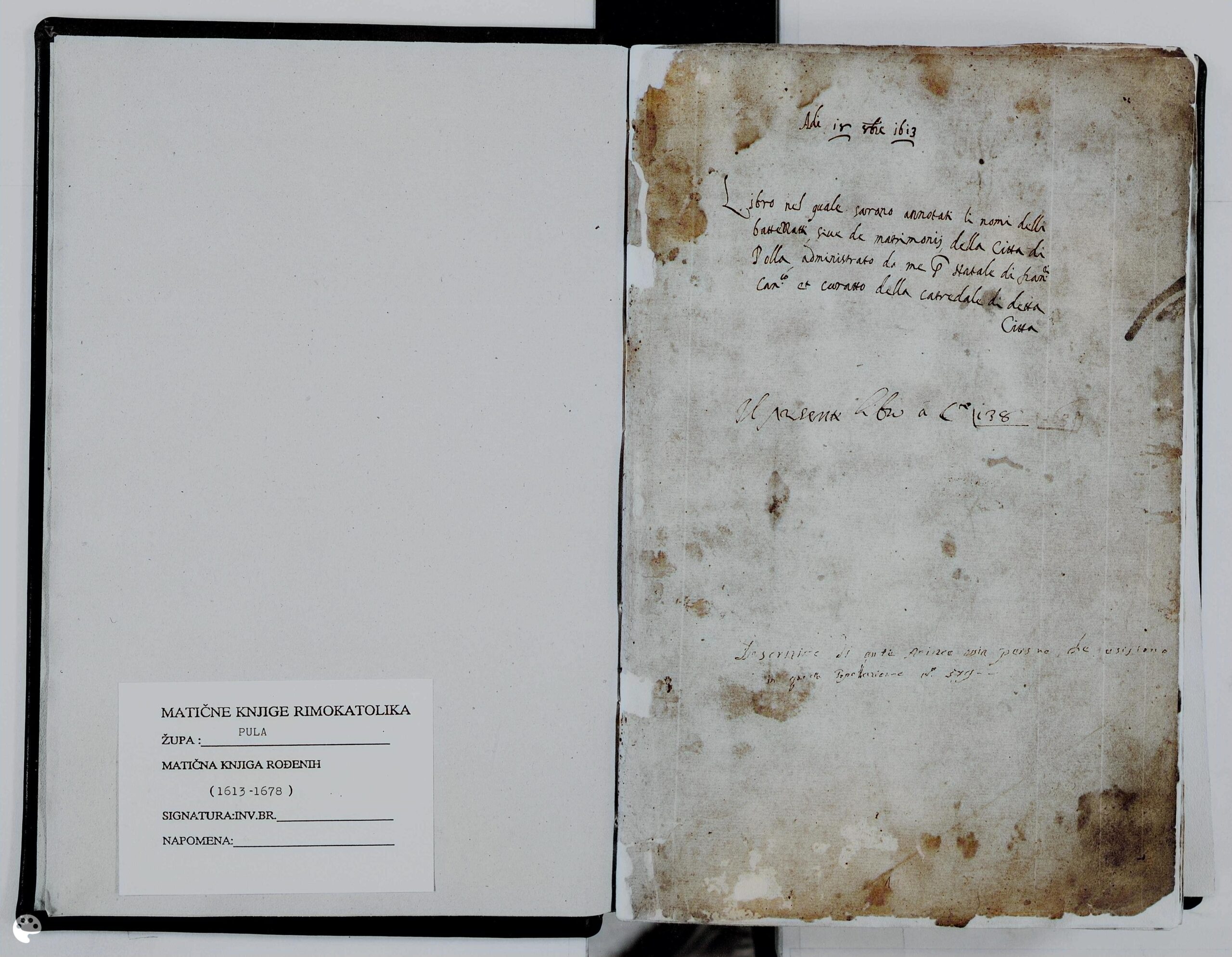
The first page of Pula’s baptismal register from October 18, 1613, featuring the introductory entry by the parish priest Don Natale de Franceschi. Translated text: “On October 18, 1613. In this present manuscript, the names of the baptized will be recorded together with the origins [nations] of the city of Pula, and it is kept by me, Don Natale de Franceschi, canon and parish priest of the Cathedral of the said City.”
Source: State Archives in Pazin (HR-DAPA-22, Parish Office Pula), Register of Baptisms 1613-1648.
City Administration and the Military
The city administration in Pula, as in the entire territory of the Venetian Republic, was in the hands of Venetian nobles, mostly originating from the Terraferma. The books frequently mention counts proveditors and other state officials: podestas, syndics, chancellors, councilors, notaries. Venice sent them to Istrian cities, and they returned after their mandate. They were not true residents of Pula, but temporary passersby. Pula’s population consisted of a large number of soldiers, military personnel, and administrative staff. The reason was the great strategic importance of Pula and the Pula region along the military maritime route used by Venice to navigate toward Dalmatia and the Levant. There were the most soldiers in the 17th century, especially around 1630, during the period of tension between Venice and Spain and the threat of an invasion of southern Istria, and again after 1780. Migrations to Pula reached their peak at the beginning of the 17th century, which is also detailed in the books.
Settlers and the Council of Nobles
From the end of the 15th century, and especially in the 16th and 17th centuries, deep ethnic changes occurred in Pula that increased the Croatian element. Migrations toward southern Istria and Pula brought many settlers from Croatian regions, who permanently settled in the city and its surroundings.
Pula was then on the verge of demographic collapse. Old statutory regulations ceased to be valid, and people who previously would not have had the right of residence began settling in the city. The Council of Nobles met less and less frequently, because a portion of the members had left Pula to live in other Istrian and non-Istrian places, and a portion of the noble families had died out. Admissions to the Council were rare, partly because there were fewer and fewer citizens who met the requirements for that honor. Due to poverty, they could not pay the relatively high sum that would compensate for their origins. The Council only partially regained its former role toward the end of the Venetian Republic’s existence.
1797: Flight from Pesaro and the Arrival of Austria
At the end of an entry about the baptism of a little girl in 1797, there is a note: the family fled Pesaro escaping Napoleon’s army. Pesaro belonged to the Papal States at the time, and the French army had entered it.
That same year, a representative of the Austrian government arrived in Pula. A special announcement was recorded in all parish registers on July 10, 1797. The Imperial-Royal-Apostolic Commissioner arrived in the city with his entourage, cavalrymen, and infantrymen. His arrival was announced by a letter from General Count de Klenau. Following his arrival, the government was reorganized.
1812: An Unfinished Book
Years later, on June 12, 1812, the mayor of the Pula municipality, acting as a representative of the Napoleonic government, made a decision: it was established that the baptismal register was not finished. According to an order from the Count Governor of Illyria from Trieste, the mayor decreed that the book should temporarily remain with the parish priest until it was handed over to the official of the Census Bureau.
Source material: Bertoša, S., Život i smrt u Puli (Matica hrvatska, Pazin, 2002.)