The Fake part of History of the Slavic Nations That Became Reality
In 1584, Admiral Petar (Don Pedro) Ohmučević “received” a confirmation from the Catholic Bishop of Bosnia, Antun Matković, stating that his family had been the most distinguished noble family in Bosnia. The bishop, however, had in fact died in 1583, and so begins a story of a historical illusion that leads all the way to the coats of arms of Serbia and Bulgaria.
Historical symbols are rarely untouched remnants of the past. According to the research of Ivo Banac, South Slavic heraldry originally contained no ideological elements whatsoever; until then, coats of arms had designated exclusively families and dynasties, not ideas about the nation and the state. All this changed with the appearance of the aforementioned Ohmučević. His manual was the product of his circle and served only to prove noble descent. By a chain of circumstances, this private forgery passed from hand to hand for centuries. Banac concludes that without Ohmučević’s manual, and without the later authors who believed in it and adopted its visual motifs (such as Mavro Orbin and Pavao Ritter Vitezović), the coats of arms of Serbia and Bulgaria as we know them today would certainly not exist.
The Ohmučević Family: Escape from Hum and the Quest for a Title
This historical episode has its roots in the time of the Turkish conquests. With the loss of Hum in 1482, the Ohmučević family was left without its ancestral estate and fled to Slano in the Dubrovnik area. Although Ivelja Ohmučević had become an exceptionally wealthy grain merchant in the Mediterranean, all that money could not buy him nobility in his new environment. The Republic of Ragusa (Dubrovnik) simply did not recognize foreign noble statuses, so the Ohmučevićs were legally classed in the lower estate. The desire for lost standing was evidently the driving force behind the family’s later ambitions.
The Ambitions of an Admiral in the Service of the Spanish Crown
Together with his brothers, Ivelja’s son Petar (known as Don Pedro de Iveglia Ohmuchievich Gargurich) sailed under the flag of the Spanish Crown. His military career was exceptionally notable, since he served as an admiral to King Philip II and took part in the Spanish campaigns against Portugal (1580) and the Azores (1582). In 1588 he commanded the Classis Illyrica, a squadron of twelve ships and 3,200 sailors, operating as part of Philip’s Invincible Armada.
However, Don Pedro was aware that all those military merits meant little at the Spanish court without official confirmation of his noble status. Before the strict authorities he had to prove the complete purity of his lineage—specifically, that his ancestors, as far back as his great-grandfathers, had belonged exclusively to the Catholic nobility, without any contact with Islamic, Jewish, or heretical roots. After Dubrovnik refused to recognize his claims in 1584, and probably again in 1588, Don Pedro invoked an invented tradition, backed by false “reliable” witnesses and forged evidence.
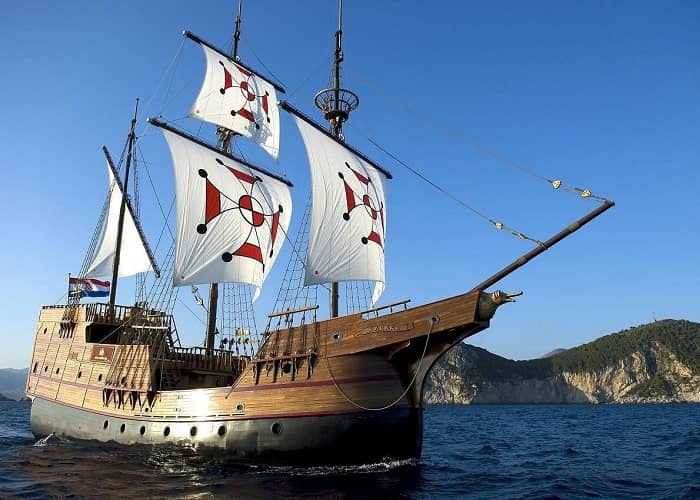
Modern replica of a traditional Dubrovnik carrack from the 16th century. Although today it is a tourist boat sailing the Dubrovnik waters, its appearance illustrates the type of sailing ship that Petar Ohmučević commanded with his squadron, the Classis Illyrica, at the end of the 16th century. Source: Absolute Croatia.
Anatomy of a Historical Deception
To prove his claims, Don Pedro submitted a “confirmation” in 1584 in which Antun Matković, the Catholic bishop of Bosnia, vouched that the Ohmučevićs had been the most distinguished Bosnian noble house before the arrival of the Turks (even though Matković himself had died as early as 1583). In addition, Petar Ohmučević deliberately interpolated his own family into the Serbian tradition about the Battle of Kosovo and Emperor Stefan Dušan the Mighty. He created a fictitious ancestor, Hrelja Ohmučević, whom the aforementioned emperor supposedly rewarded in 1349 with the province and city of Kostur in Macedonia for his loyal service. As the real model for this character he evidently used the protosebastos Hrelja from Dušan’s court, who in fact died in 1342, a full seven years before the emperor’s alleged reward.
In 1594, Don Pedro presented his case directly to the Spanish viceroy in Naples, and the royal council handed him a confirmation of nobility on May 17. After that, on top of everything, he attached a heraldic armorial as his crowning piece of evidence. In 1596, three years before his death in Lisbon, he became a Knight of Saint James.
The Korjenić-Neorić Armorial
Although Don Pedro’s original no longer exists, at least sixteen copies of it survive, and the chronologically oldest bears the name Korjenić-Neorić Armorial (1595). It is a bilingual text in which the Croatian part is written in Bosnian Cyrillic (Bosančica), with numerous errors that undoubtedly reveal the hand of a foreigner. According to the manual’s false tradition, the original was created in 1340 at Emperor Dušan’s court by the “ban of coats of arms,” Stanislav Rubčić. Against this stands the historical truth: the collection is the product of Ohmučević’s circle of collaborators, with historian Aleksandar V. Solovjev attributing the authorship to Don Pedro’s close friend, a Franciscan from Slano named Beno Orsini. Fate brought the armorial in the 19th century into the hands of Ljudevit Gaj, who bought it in Dubrovnik and moved it to Zagreb.
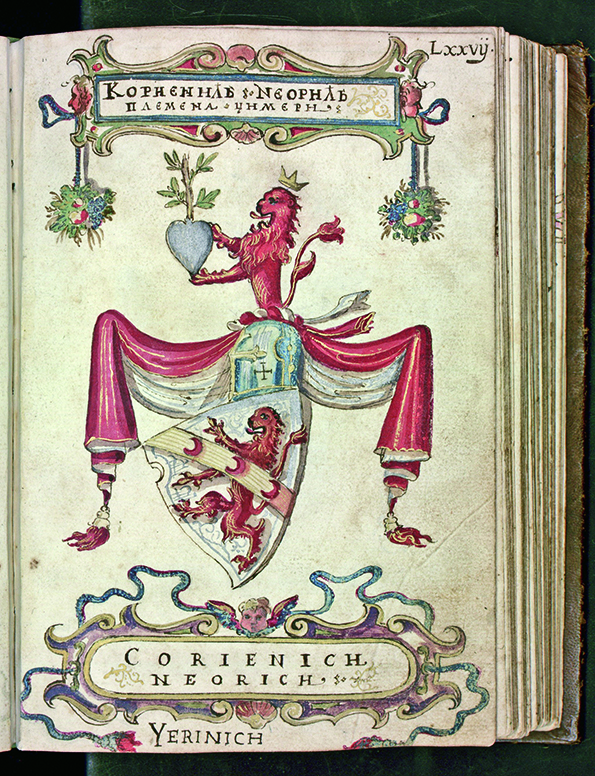
This is a page from the Korjenić-Neorić armorial showing the coat of arms of the Korjenić-Neorić-Jerinić family (1595). It is the oldest surviving copy of Ohmučević’s original heraldic manual. The Korjenić-Neorićs, as the commissioners and financiers of this 1595 copy, probably inserted their own lavish coat of arms into Ohmučević’s “ancient” book in order to falsely prove their own ancient noble descent. Source: Matica hrvatska, Vijenac no. 575.
Heraldic Engineering and Borrowings
The manual contained 157 heraldic depictions in total, but the key to understanding this deception lies in the first sixteen tables, where the history of the South Slavs is directly subordinated to the Ohmučević family’s goals. The most obvious example of this manipulation is the lavish composition “Cara Stipana Stiepana Nemagnića cimer” (“Crest of Emperor Stipan Stiepan Nemagnić”), invented as the united coat of arms of Dušan’s empire. Its hierarchical arrangement illustrates the family’s priorities: Macedonia is placed ahead of Bosnia because the Ohmučevićs claimed their greatest influence there, while Bulgaria was given a place before Serbia. Furthermore, Raška, as the core of old Serbia, is set apart and positioned right next to the Littoral (Primorje), the true homeland of the Ohmučevićs. On top of all this, the visual construct also contains the coat of arms of Illyria (a red shield with a silver crescent and an eight-pointed star), which is fitted within the motif of Bosnian keys with Moors’ heads under the protection of the Virgin Mary.
One smaller part of the collection does indeed reflect historically grounded symbols, as can be seen in the Byzantine origin of the Serbian cross, the double-headed eagle, and the Macedonian, Bulgarian, and Kotromanić lions. Yet Ohmučević’s authors, in creating most of the coats of arms, reached for contemporary Western European books. Virgil Solis’s armorial of 1555 served them as a blueprint for the title and the arrangement of the emblems, but also as a direct template for the territorial arms of Dalmatia, Croatia, Slavonia, and Bosnia. For the arms of Illyria, Bosnia, and Slavonia, they relied on Münster’s Cosmographia, probably using the Italian edition printed in 1575. It is precisely in this work by Münster that early traces of the concept of Illyrian unity are found, in which Bosnia, Slavonia, Croatia, Carniola, and Carinthia are treated as shared Illyrian provinces.
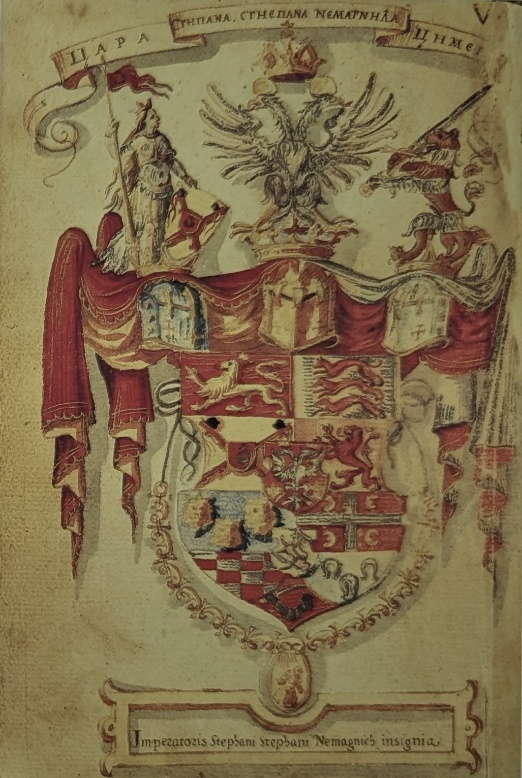
The table “Crest of Emperor Stipan Stiepan Nemagnić” from the Korjenić-Neorić armorial (inscription at the bottom: Imperatoris Stephani Stephani Nemagnis insignia). This lavish bilingual depiction illustrates Ohmučević’s heraldic forgery: around the central double-headed eagle of the Nemanjićs are united the borrowed territorial arms of Bosnia (keys and Moors’ heads), Dalmatia (three crowned heads), Croatia (checkerboard), Slavonia (stripes with a marten), Serbia (cross with firesteels), Macedonia and Bulgaria (lions), and Raška (three horseshoes). In the upper left corner, the arms of Illyria (star and crescent) are additionally emphasized under the protection of the Virgin Mary. Source: Ivo Banac, Grbovi: biljezi identiteta.
The Transfer into Historiography: Bobaljević and Orbin
The armorial probably entered serious historiography by way of Marin Bobaljević, a Dubrovnik nobleman who spent most of his life in exile (after killing two noblemen, one of them in a church itself). Banac considers it entirely probable that in Naples his path crossed with Don Pedro’s. Just like Ohmučević, Bobaljević felt an urge to show uninformed foreigners the greatness of the “Slavic nation,” but these ideas lacked a real historian. In Pesaro, where he was gathering sources in the library of the Duke of Urbino, Mavro Orbin, a Benedictine abbot from Mljet, came upon him. With Bobaljević’s financial support, Orbin published his well-known work Il regno degli Slavi in 1601.
In his first chapter, Orbin drew on Vinko Pribojević, a Dominican from Hvar who as early as 1525 had addressed the nobility of his native town with a speech on the origin of the Slavs. Having titled that chapter, Orbin in effect reworded Pribojević, but he made a key leap by introducing the idea of a Slavic empire, thereby taking over the central motif from Don Pedro’s falsified armorial. Banac believes that Orbin probably received Don Pedro’s manual from Bobaljević’s hands and handled it critically: in his text on Emperor Dušan there is no mention of the invented Hrelja Ohmučević, and one of his sources names a completely different Serbian magnate as lord of Kostur. Nevertheless, if the coat of arms of Hum is excluded, ten of the eleven coats of arms in Orbin’s book were transferred directly from the Korjenić-Neorić armorial and from its lost prototype.
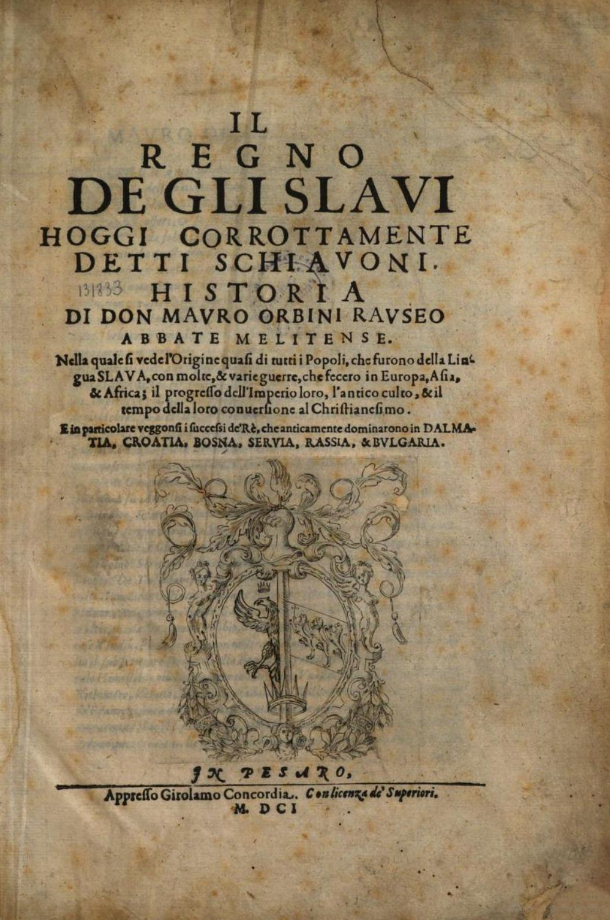
Title page of Mavro Orbin’s Il regno degli Slavi (The Kingdom of the Slavs), printed in Pesaro in 1601. Orbin carried ten of the eleven coats of arms from Ohmučević’s collection into this book, whereby the forgery entered serious literature. The page reads: “THE KINGDOM OF THE SLAVS, TODAY INCORRECTLY (CORRUPTEDLY) CALLED SCHIAVONI [Sklavoni]. HISTORY OF DON MAVRO ORBIN OF DUBROVNIK, ABBOT OF MLJET. In which can be seen the origin of almost all the peoples who spoke the Slavic language, with the many and various wars they waged in Europe, Asia, and Africa; the progress of their empire, their ancient faith, and the time of their conversion to Christianity. And in particular can be seen the successes of the kings who in ancient times ruled in DALMATIA, CROATIA, BOSNIA, SERBIA, RAŠKA, and BULGARIA. IN PESARO, at Girolamo Concordia’s. With permission of the superiors. 1601.” Source: Google Books, digitized archival material.
Vitezović and the Birth of Revolutionary Symbols
Until recently it was thought that the Croatian polymath Pavao Ritter Vitezović took his coats of arms from Orbin, but Banac notes that this holds true for only a small part of them. After a detailed study of Marsigli’s legacy in Bologna, Aleksandar V. Solovjev concluded that Vitezović had in fact relied on two later versions of Ohmučević’s manuscript that were already in his personal possession. His Stemmatographia was published in Vienna in 1701. Pan-Croatism is usually described as a historical construct and a political program: through it, Vitezović wanted to show that all Slavs were in fact Croats. The Stemmatographia is the heraldic side of his Croatia rediviva (1700), a protest against the centuries-long dismemberment of Croatian lands and at the same time a legitimist plea for help addressed to the Habsburgs. Of the 56 coats of arms in the collection, twelve he borrowed (directly or indirectly) from the Ohmučević tradition, while he evidently invented the coats of arms himself for ancient regions such as Japodia and Triballia (to which he assigned the motif of a boar’s head pierced by an arrow).
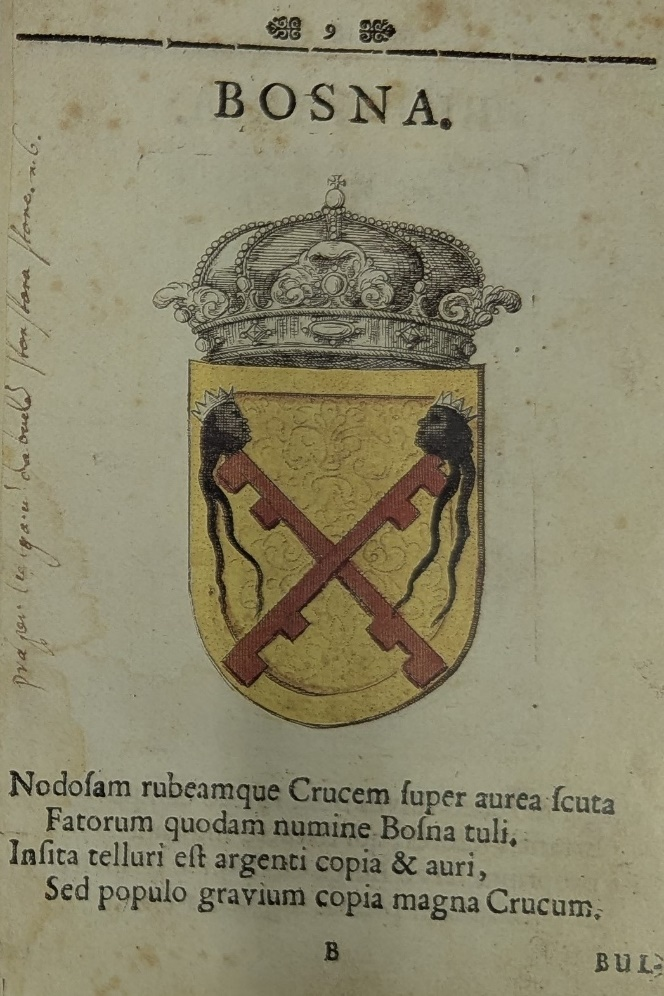
Coat of arms of Bosnia from Pavao Ritter Vitezović’s Stemmatographia, printed in Vienna in 1701. The motif on the golden shield, showing crossed red staffs and two crowned Moors’ heads, was borrowed by Vitezović in reliance on Ohmučević’s heraldic tradition (that is, the Korjenić-Neorić armorial). Characteristically for the Stemmatographia, beneath the coat of arms is Vitezović’s Latin epigram, which poetically interprets the history and heraldic symbolism of the depicted territory: “A knotty red cross on a golden shield, by some decree of fate, I, Bosnia, have borne. In my land lies hidden an abundance of silver and gold, but to my people belongs a great abundance of heavy crosses.” Source: Ivo Banac, Grbovi: biljezi identiteta.
The Bulgarian iconographer Hristofor Žefarović printed this collection again in Vienna forty years after Vitezović, working on the orders of the Serbian Patriarch Arsenije IV. Although graphically he copied Vitezović almost entirely, Žefarović incorporated figures of Serbian kings and saints into the collection. With this act the work took on a quite different meaning, strongly influencing heraldic development among the Serbs, the Bulgarians, and, in part, the Romanians. In this connection Ivo Banac warns of a practice in nationally tinged historiography that seeks to trim the role of Vitezović and Don Pedro, going so far that Bulgarian authors sometimes call Žefarović the founder of modern Bulgarian heraldry. The concrete application of these coats of arms is visible as early as 1804 in the First Serbian Uprising, when the painter Stefan Gavrilović decorated Karađorđe’s first banner with motifs of Saint Stefan the First-Crowned and with Vitezović’s and Žefarović’s Serbian coats of arms. The same heraldic sources from the Stemmatographia served Karađorđe for his personal seal (with the arms of Serbia, Bosnia, and the Nemanjić state), as well as for the emblem of the Praviteljstvujušči sovjet (Governing Council), on which the engraved arms of Serbia and Triballia appeared.
The Illyrian Movement and the Democratization of Coats of Arms
The leader of the Illyrian movement, Ljudevit Gaj, treated heraldry as an auxiliary historical discipline, showing marked contempt for those he called “lajkuši in rebus heraldicis” (laymen in heraldic matters). Despite this attitude, he was deeply convinced that the Korjenić-Neorić armorial provided an authentic picture of everyday court life in the state of the Nemanjićs. Studying that collection, Gaj drew the conclusion that a genuine court heraldic institute had existed, run by a high official with the title “ban cimerja” (ban of crests). How much he valued that document is best shown by the fact that, as soon as he managed to obtain the Korjenić-Neorić copy, he entirely neglected the Fojnica armorial, which he regarded as a considerably cruder piece of work.
The main symbol of his movement was the Leljiva, a combination of a young moon and a six-pointed Danica (morning star). Gaj interpreted it through Slavic mythology: for him the star was Lada, the goddess of love and beauty, and the young moon was Lelj, the god of love, who turns his little horns toward the star as if wanting to catch it. Interestingly, the coat of arms of Illyria in Ohmučević’s armorial also has a crescent and a Danica, but an eight-pointed one, whereas Gaj’s is six-pointed. It is hard to say with certainty whether this is merely a historical coincidence or a conscious borrowing of the motif. Gaj brought the Leljiva into general circulation: we find it on the masthead of Danica ilirska, on Viennese porcelain cups bearing the words “God save all Illyrians, that they may unite and expand,” on tarot cards, and on ladies’ fans for Illyrian balls. On his desk clock stood the inscription “The hour will strike for us too!”
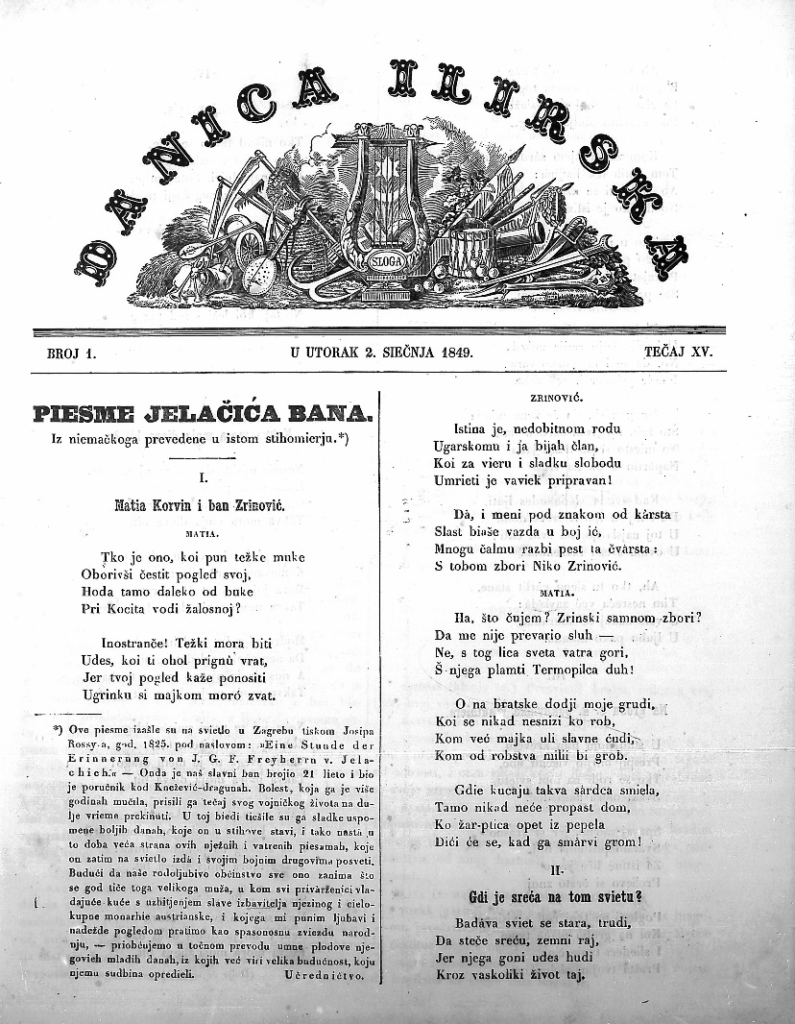
Masthead of the first issue of Danica ilirska from 1849. At the very center of the lavish illustration, Gaj’s Leljiva (six-pointed star and crescent) dominates, a heraldic motif found in Ohmučević’s armorial which, thanks to the Illyrian movement, became a recognizable mass national symbol. Source: Portal of digitized newspapers “Stare hrvatske novine,” National and University Library (NSK) in Zagreb.
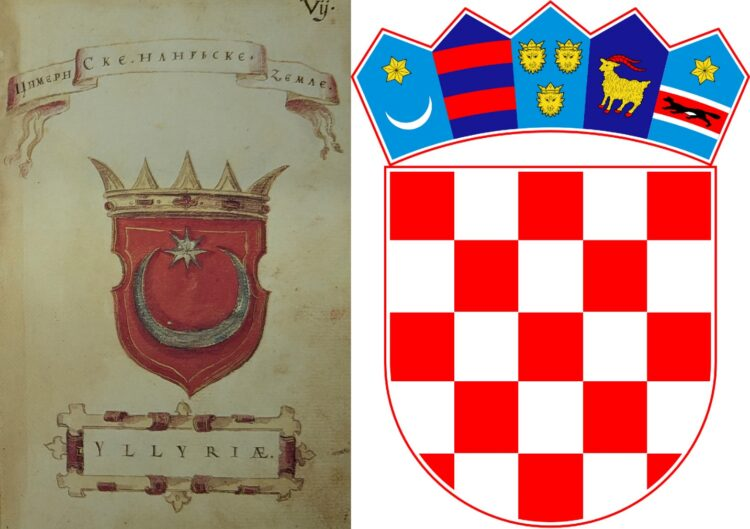
Left: the arms of Illyria from the Korjenić-Neorić armorial (table VII), red background with a silver crescent and an eight-pointed star. Right: the coat of arms of the Republic of Croatia (1990) with a crescent and a six-pointed star. In the crown of the coat of arms is the Illyrian Leljiva, politically legitimized as the “oldest Croatian coat of arms.” Source: Ivo Banac, Grbovi: biljezi identiteta (left); Wikipedia / Wikimedia Commons (right).

The Irony of the National Revival and the Power of Heritage
With the arrival of the national revivals in the 19th century, the newly emerged bourgeois class simply appropriated these old courtly and noble symbols, turning them, through romantic fervor, into the emblems of the modern nation. The irony is that Gaj, who despised laymen in heraldry, believed in an armorial that is certainly the work of Ohmučević’s circle. In this way Ohmučević and his successors unintentionally prepared the iconographic and ideological side of Croatian and Serbian national ideologies well before the initial phases of the revival.
In the end, the coats of arms outlived the story for which the whole manual was originally created, even though most of its visual elements were borrowed anyway. The symbols assembled in the sixteenth century survived. According to Banac, nationhood and its symbols are, all things considered, in harmony with the principle of continuity—the lasting fact that national identities do not start from scratch.
This text draws on Ivo Banac’s book Grbovi: biljezi identiteta (Coats of Arms: Markers of Identity; Grafički zavod Hrvatske).
This case demonstrates how historical symbols can alter history and later serve in political and ideological rivalries. On the other hand, the authentic development of the national symbol—the Croatian coat of arms and checkerboard—is illustrated in our previous post, How the Croatian Checkerboard Was Created: From the Bulwark of Christianity to Independence.