Fifth Marriage, Sickbed, and a Prison Church: Unusual Records from Pula’s Marriage Registers, 1613–1815
An analysis of these records, kept in Pula between 1613 and 1815, provides us with a very clear picture of the society, church regulations, and the dynamics of entering into marriage. Similar to the analysis of godparenting in the 18th century, these registers were regularly filled out by priests, who predominantly wrote in the first person and mostly used the Italian language. Interestingly, Latin was actually quite rare—over the observed period of more than two centuries, Latin texts in the marriage registers were scarce, accounting for only 5.64% of the total number of entries. On average, relatively few marriages took place annually in this area at the time, only 8.77 couples, and the dynamics of marriage heavily depended on the seasons and months. It is easy to notice that the distribution of weddings throughout the year was not at all even. Most marriages were concluded in February, with as many as 257 entries, and in June with 217 weddings. On the other hand, March and December were the months with by far the fewest weddings—only 67 in March and 65 in December. This dynamic was likely directly conditioned by the strict church calendar, namely the prohibition of celebrations during the periods of Lent and Advent, as well as the inevitable rhythm of agricultural work that dictated the pace of life.
The Dynamics of Marriage Across Decades
Considerable fluctuations are visible in the observed period when analyzing the number of recorded weddings. Statistical data shows that the lowest number of marriages per year was concluded in the period from 1658 to 1679, when the average was roughly 7 marriages annually. Conversely, the highest number was reached about a hundred years later, in the period from 1768 to 1789, with an average of 11 marriages annually. Although there were occasional declines and historical turbulences, the total number of concluded marriages generally grew throughout the analyzed period, which is natural and directly tied to the recovery and growth of the local population.
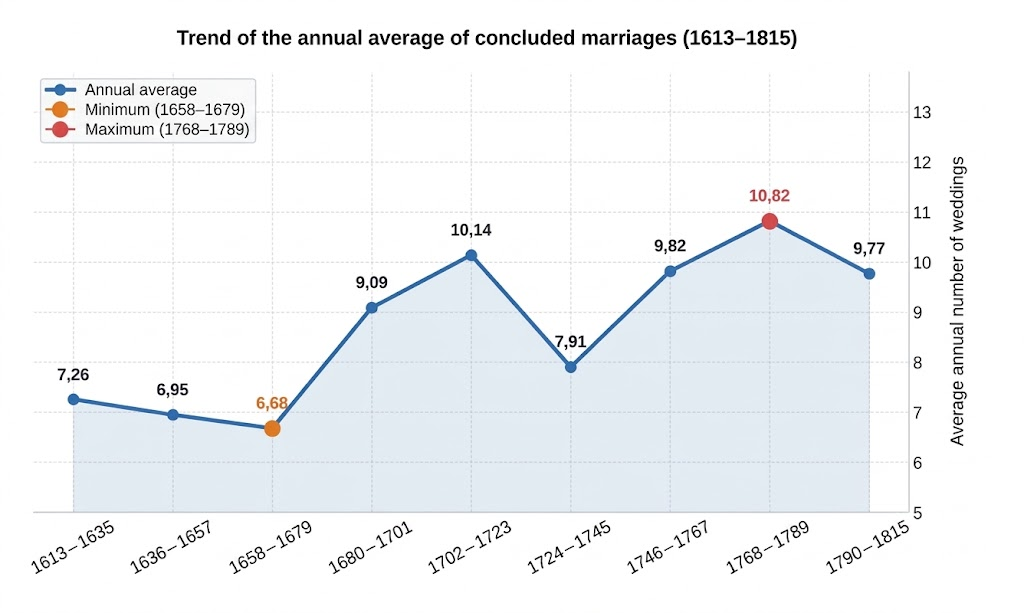
Graph 1: Shows the average number of concluded marriages by period
Procedure, Supervision, and Strict Rules
The procedure for entering into marriage was strict and very thorough. The main details included the name, surname, and previous place of residence of the newlyweds, and very often the names of their parents, with a regular indication of whether the parents were living or deceased at that time. For a marriage to be concluded at all, it was necessary to make three church banns, known as publications, over three holidays or three Sundays. The purpose of this multi-week custom was to ensure that there were no hidden legal or moral obstacles to the marriage within the community. If the future spouses did not come from the same parish, the priest performing the ceremony had to obtain official written confirmation of their freedom to marry from their respective parishes.
Naturally, these banns sometimes actually worked. A picturesque example is Zuanne Salinbena from Carnia, who contested the wedding of Sualdo Sandri and the widow Jela precisely during the three marriage announcements in April 1713. The dispute began before the church court, but the vicar dismissed it as unfounded, and the wedding proceeded.
However, the validity of all these details entered into the registers depended greatly on whether the parish priest made the entries strictly according to the rules. It is recorded, for instance, that on February 7, 1775, the bishop personally inspected the marriage registers and demanded additional order. The bishop requested that the phrase “by word of those present” be mandatorily entered in the book next to every mutual consent or the act of marriage itself, that the full date be included in the record, and that the parish priest’s signature be secured after a collective entry or at the bottom of each page. He demanded that everything else continue to be performed as before, but absolutely nothing differently.
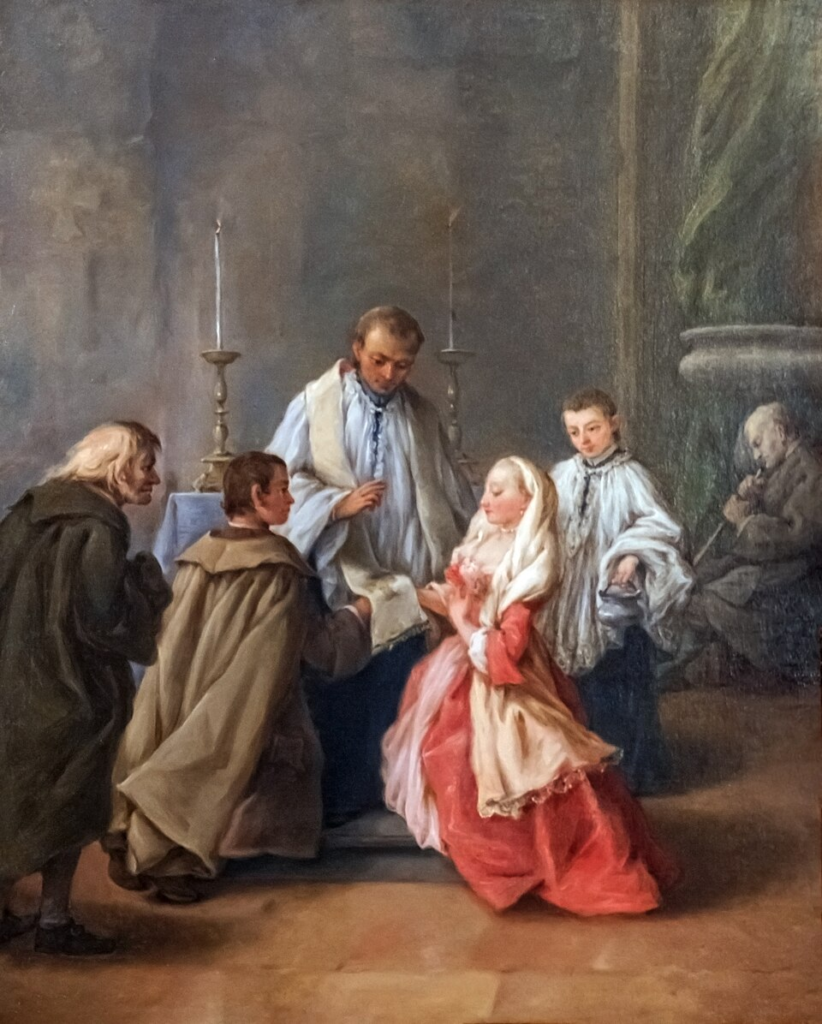
Pietro Longhi: The Marriage (Il Matrimonio), circa 1755–1757. The painting depicts the wedding ceremony inside a church or chapel in the 18th century. The priest leading the ceremony is clearly visible while the newlyweds and godparents stand before him. Since Pula was part of the Venetian Republic in the 18th century, the ceremony looked very similar. The image illustrates how parish priests (such as canons and curates) took pen in hand and wrote the names of the newlyweds and their witnesses in the Liber Matrimoniorum (marriage register).
The Age of the Newlyweds and the Phenomenon of Multiple Marriages
In addition to basic biographical data, the registers provide a clear demographic cross-section of the society at the time. Men entered their first marriage on average at just under twenty-five years of age (more precisely 24.9), while women were somewhat younger, averaging 22.5 years. However, what attracts the most attention is the frequency of remarriages.
During the observed period, 1558 men and 1327 women entered into their first marriage. Yet, statistics show that twice as many women entered into a subsequent marriage compared to men; 170 men and as many as 401 women entered a second marriage. Thirty-nine men and 37 women entered a third marriage, while a fourth marriage was recorded for 4 men and 5 women. A fifth marriage was also documented, entered into by only one man and two women.

Table 1: Shows the number of multiple marriages
The reasons for such a high number of multiple marriages and the evident disproportion between the sexes usually lie in the sheer existential pragmatism of widows who secured survival through a new marriage, but also in the possibility that widowers were not always meticulously recorded. Given that ecclesiastical annulment of marriage was almost impossible at the time, these figures directly testify to the high mortality rate in the population of that era. Combinations at the altar were diverse—from a woman entering a marriage for the first time with a man who was remarrying, to specific examples like the one on February 5, 1769, when Matija Skomeršić, a woman from Krk, entered her fourth marriage with Dominik Kujica, for whom it was only his first. Marriages between two widowed individuals were also clearly present.
Property Relations – the Pula and Venetian Way
The issue of inheritance and property disposal was of crucial importance. The property-legal relations of spouses were regulated in two main ways: through a marriage in the Pula or Istrian way (more polesana) and through a marriage in the Venetian way (alla venetiana). It is estimated that the vast majority of unions, specifically over 99% of marriages, were concluded in the Pula way.
The main characteristic of this local model was a fairer distribution—ownership of items acquired before marriage remained separate, while the house and other goods were jointly owned. In contrast, marriage in the Venetian way implied a significantly more difficult position for the woman, who was the owner only of her own dowry. In the event of her husband’s death, according to this rule, the widow had to leave the house within a year and a day, which in practice meant she had to remarry to secure a roof over her head.
Exceptions, Unusual Locations, and Special Cases
Although the rules prescribed a strict form, actual practice recorded numerous life exceptions. The marriage ceremony did not always take place before the altar in a church. The records mention very specific situations where a marriage, naturally with special permission, was concluded at home because the future husband was severely ill and bedridden at the time. Weddings were also recorded in the proveditore’s palace, sometimes even without the previously required three banns, and even in the church of the Pula fortress simply because the future husband was residing there as a prisoner.
Such exceptions to church rules were approved exclusively for serious and justified reasons. For example, an urgent wedding was recorded on January 25, 1805, between Giuseppe from Brescia and Lucietta from Koper. It was a fast-tracked marriage because Giuseppe was in direct mortal danger, so a special oath and an extraordinary fast permit from the bishop were required to conclude the union.
On the other hand, the weddings of prominent people of the time were often more special. In such elite cases, the ceremony was performed by the bishop, with written permission arriving from Rome, or even by vicars general. The registers thus neatly record marriages that were concluded inside the bishop’s palace itself.
Although extremely rare, there is even mention of the official annulment of an old marriage in order to enter into a new one. The unusual case of a certain Mauritia from Crema is known; she had her previous marriage with Lodovico annulled by the church, after which she managed to marry Simon from Val Cominiche. One of the more interesting details is a record in which a certain Captain Alberto and the widow Lauretta stood before the altar, legitimizing an already born child through their marriage, while the captain himself lay ill in bed at the time.
A Mirror of Past Times
The marriage registers represent much more than a mere population registry. They are a direct historical source that testifies to demographic trends, legal customs, and the real challenges of the society of that time. From strict rules for entering into marriage to a high rate of remarriages born out of necessity, these records allow us an accurate reconstruction of how the Pula community functioned and survived through the centuries.
Source material: Bertoša, S., Život i smrt u Puli (Matica hrvatska, Pazin, 2002.)
One Comment